

The direct effect of virus-blaming in the Atlanta shooting
- Sacha Nouyou
- Mar 29, 2021
- 4 min read
Updated: Apr 5, 2021
Anti-Asian racism and Covid-19 fuelled xenophobia lead to hate incidents towards the AAPI communities nearly double in a year.

Unsplash/Jason Leung
On March 16th, after a year of violent attacks against Asian Americans and anti-Asian racism, white suspect Robert Aaron Long entered three massage parlours and performed a series of mass shootings in Atlanta, Georgia. Eight people were killed, six of whom were Asian women.
Anti-Asian racism grew exponentially in America during the pandemic - charged by xenophobic virus-blaming enforced by leaders across the country. Between March 19th 2020, and February 28th of this year, there were 3,800 anti-Asian hate incidents in America, according to research by Stop AAPI (Asian Americans and Pacific Islanders) Hate. This is nearly double the figure from the previous year, which stood at 2,600 hate incidents. The research also found that women were the victims of 68% of attacks, compared to 29% of male victims.
Asian-American designer Philip Lim said, "It feels as if we do not really matter or exist" in a video uploaded to his Instagram page. Lim has become a leader in the AAPI community, uplifting and empowering a group who have been blamed by their government for a pandemic and left with no support. Lim is one of the organisers of a 'Running for Protest' event in New York City, which calls for continued solidarity among Black and Asian communities against anti-Asian racism.
The violence towards the Asian community has been captured in viral videos throughout the pandemic, with multiple videos showing Asian American's being physically assaulted. In one video, an 84-year-old Thai man was fatally assaulted in broad daylight in San Francisco in early 2020. In another, a 52-year-old Asian American woman was attacked outside a bakery in New York City. This violence against Asian American's is growing - according to a study by the Center for the Study of Hate and Extremism, anti-Asian hate crimes increased by 149% from 2019 to 2020.
Anti-Asian racism was seen throughout all layers of power during the pandemic. Most obviously, in former President of the United States, Donald Trump. On March 16th 2020, Trump first used the phrase 'Chinese virus', on Twitter. Following Trump's tweet, a mass of tweets using the hashtag #ChineseVirus followed, along with other anti-Asian phrases. The dominant term on Twitter the following week was #ChineseVirus, according to a study published by researchers at the University of California in San Francisco.
This anti-Asian narrative can also be seen in lower-levels of power. The Cherokee Country Sheriff's captain, Jay Baker, was removed as spokesman for the investigation into the Atlanta Shootings after saying that the suspect denied that the attack was motivated by race and that "yesterday was a really bad day for him, and this is what he did". A Facebook page appearing to belong to Baker promoted a T-shirt with racist language about China and the coronavirus.
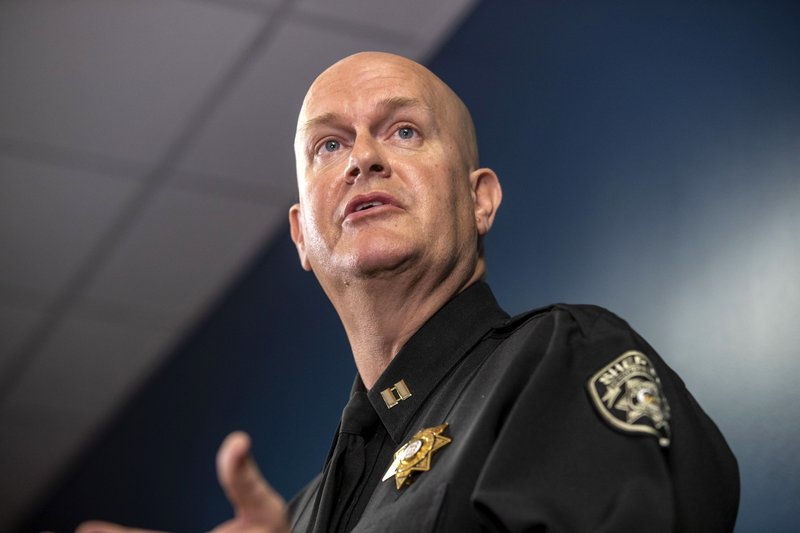
Captain Jay Baker Alyssa Pointer/Atlanta Journal-Constitution via AP
Following the attack, President Joe Biden issued an executive order on the attacks and criticised Donald Trump and other federal officials who repeatedly talked of Covid-19 as the 'China virus' and 'kung flu'. The order calls for better data collection about hateful incidents and mandates federal agencies to fight 'racism, xenophobia and intolerance directed towards the Asian American community. When Biden announced the bill, he added, "for all the good that laws go, we have to change our hearts. Hate can have no safe harbour in America. It has to stop. It's on all of us, all of us together, to make it stop."

Unsplash/Jason Leung
There has long been an anti-Asian rhetoric in America - all the way back to the Chinese massacre of 1871 when a mob in Los Angeles' Chinatown attacked and murdered 19 Chinese residents. This was a reflection of the growing anti-Asian sentiment that culminated with the Chinese Exclusion Act of 1882. The act banned Chinese labourers' immigration, similarly to the Page Exclusion Act of 1875, America's first restrictive immigration law, which prohibited the entry of Chinese women into the country. 120,000 Japanese Americans were imprisoned on the West Coast of America as a response to the attack on Pearl Harbour. Throughout histroy, Asian American's have been judged exclusively on their native countries and family histories - and have had to suffer indisputably from the xenophobia and violence from those who judge them.
Designers, celebrities and influencers, including Olivia Munn, Prabal Gurung and Daniel Day Kim, took to their social media in the wake of the Atlanta shooting to support the #StopAsianHate movement, and rallies took place across America. In Atlanta, hundreds of people gathered near the Georgia State Capitol, some demonstrators carrying signs demanding 'Stop Asian Hate.' During a Stop Asian Hate rally in Los Angeles, a man drove through a red light into a crosswalk where protesters were marching. The man yelled racial slurs as he drove on to the route where the rally was scheduled to take place. It is being investigated as a hate crime by the Los Angeles Country Sheriff's office.
Georgia's state representative Bee Nguyen, an advocate for women and communities of colour, addressed Atlanta after the shooting. "No matter how you spin it, the facts remain the same. This was an attack on the Asian community. Let's join hands with our ally community and demand justice for not only these victims, but for all victims of white supremacy".


Comments